

osbng Indexing Polygon Examples#
The indexing functions within the osbng package are contained within the osbng.indexing and osbng.indexing_gpd modules.
The osbng.indexing.geom_to_bng and osbng.indexing.geom_to_bng_intersection functions enable the indexing of geometries, represented using `Shapely <shapely/shapely>`__ Geometry objects, into grid squares at a specified resolution. Both functions accept Shapely Geometry objects of the following types: Point, LineString, Polygon, MultiPoint, MultiLineString, MultiPolygon, and GeometryCollection. The geometry coordinates must be encoded in
the British National Grid (OSGB36) EPSG:27700 coordinate reference system. The functions operate directly on Shapely Geometry objects allowing you to use these functions with standard Python data structures (e.g., lists, dictionaries) containing Shapely geometries.
The osbng.indexing_gpd.gdf_to_bng_intersection_explode function enables the indexing of geometries in a `GeoPandas <geopandas/geopandas>`__ GeoDataFrame to BNGIndexedGeometry objects, and the explosion the the resulting lists into a flattened GeoDataFrame.
These functions facilitate grid-based spatial analysis, enabling applications such as statistical aggregation, data visualisation, and data interoperability.
Optional GeoPandas Dependency#
Unlike the osbng.indexing module which relies on Shapely alone, the osbng.indexing_gdf module requires the GeoPandas package to be installed.
Indexing Shapely Geometries#
The geom_to_bng and geom_to_bng_intersection functions differ in their operation. geom_to_bng returns the BNG grid squares intersected by the input geometry, while geom_to_bng_intersection returns the intersections (shared areas) between the input geometry and the grid square geometries.
When deciding between the two functions, consider whether a decomposition of the input geometry by BNG grid squares is required. The decomposition logic is computationally more expensive but is useful when the intersection between the input geometry and a grid square is needed. This approach supports spatial join optimisations, such as point-in-polygon and polygon-to-polygon operations, using the is_core property of the BNGIndexedGeometry object. These optimisations are particularly
valuable for geospatial analysis of medium to large datasets in distributed processing systems, where geometries may be colocated by their BNG references.
geom_to_bng#
This function returns a list of BNGReference objects representing the BNG grid squares intersected by the input geometry. Note that BNGReference objects are deduplicated in cases where multiple parts of a multi-part geometry intersect the same grid square.
geom_to_bng_intersection#
This function returns a list of BNGIndexedGeometry objects representing the decomposition of the input geometry into BNG grid squares. Unlike geom_to_bng, no deduplication occurs. If multiple parts of a multi-part geometry intersect the same grid square, the intersection for each part is returned.
Indexing GeoPandas GeoDataFrames#
gdf_to_bng_intersection_explode#
This function applies the geom_to_bng_intersection function to each geometry in a GeoPandas GeoDataFrame, returning a flattened GeoDataFrame by exploding the resulting lists of BNGIndexedGeometry objects.
Examples#
The examples below demonstrate the application of the indexing functions using boundary data from the administrative England Regions dataset provided by the Office for National Statistics (ONS). Metadata for this dataset is available in ../data/metadata.json.
[13]:
import geopandas as gpd
from matplotlib import patheffects
from matplotlib import pyplot as plt
from matplotlib.lines import Line2D

from osbng.indexing import geom_to_bng, geom_to_bng_intersection
from osbng.indexing_gpd import gdf_to_bng_intersection_explode
[14]:
# Read the Office for National Statistics (ONS) England Regions GeoPackage
# Create a GeoPandas GeoDataFrame
# See ../data/metadata.json for more information about the data source
gdf = gpd.read_file("../data/Regions_December_2024_Boundaries_EN_BFC.gpkg")

# Convert column names to lowercase
gdf.columns = gdf.columns.str.lower()

# Filter the GeoDataFrame
# Keep only the Greater London region
gdf_london = gdf[gdf["rgn24nm"] == "London"][["rgn24cd", "rgn24nm", "geometry"]]

# Return GeoDataFrame
gdf_london
[14]:
| rgn24cd | rgn24nm | geometry | |
|---|---|---|---|
| 6 | E12000007 | London | MULTIPOLYGON (((531024.595 200933.623, 531023.... |
[15]:
# osbng.indexing functions require geometry coordinates to be specified
# in British National Grid (BNG) (OSGB36) cordinate reference system
# EPSG:27700
# https://epsg.io/27700
gdf.crs
[15]:
<Projected CRS: EPSG:27700>
Name: OSGB36 / British National Grid
Axis Info [cartesian]:
- E[east]: Easting (metre)
- N[north]: Northing (metre)
Area of Use:
- name: United Kingdom (UK) - offshore to boundary of UKCS within 49°45'N to 61°N and 9°W to 2°E; onshore Great Britain (England, Wales and Scotland). Isle of Man onshore.
- bounds: (-9.01, 49.75, 2.01, 61.01)
Coordinate Operation:
- name: British National Grid
- method: Transverse Mercator
Datum: Ordnance Survey of Great Britain 1936
- Ellipsoid: Airy 1830
- Prime Meridian: Greenwich
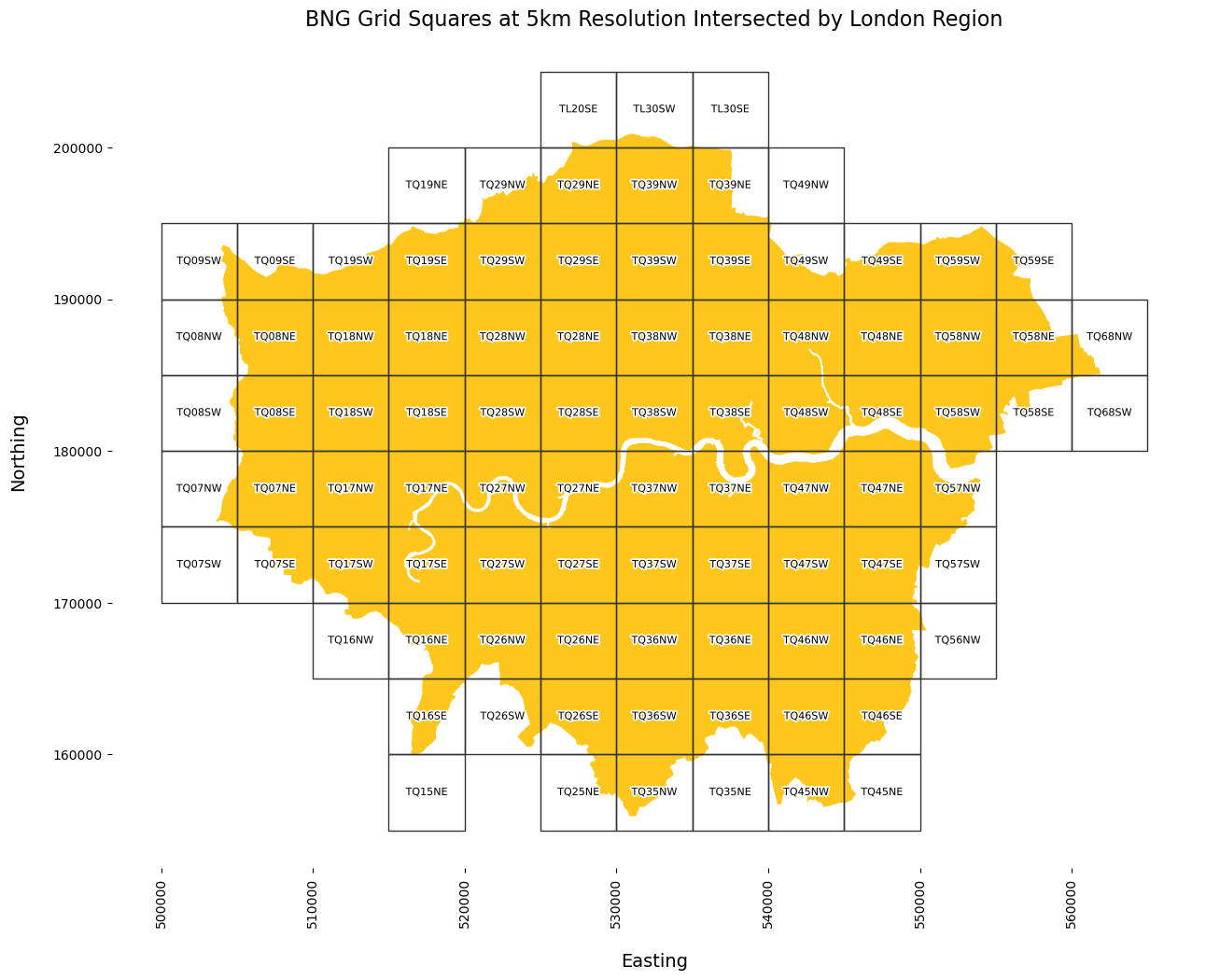
geom_to_bng#
Returns a list of BNGReference objects representing the BNG grid squares intersected by the input geometry. The BNGReference provides properties and methods to access and manipulate the reference. This includes the following property and method used below:
bng_ref_compact: The BNG reference with whitespace removed.bng_to_grid_geom(): Returns a grid square as aShapelyPolygon.
[16]:
# Create a copy of the GeoDataFrame
_gdf_london = gdf_london.copy()

# Return the BNG grid squares intersected by the London Region
# Uses the geom_to_bng function from the osbng.indexing module
# Returns a list of BNGReference objects
_gdf_london["bng_ref_5km"] = _gdf_london["geometry"].apply(
    lambda x: geom_to_bng(geom=x, resolution="5km")
)

# Drop the original geometry column
_gdf_london = _gdf_london.drop(columns=["geometry"])

# Explode the bng_ref_5km column to separate rows for each BNGIndexedGeometry object
_gdf_london_exp = _gdf_london.explode("bng_ref_5km", ignore_index=True)

# Return the first few rows of the GeoDataFrame
_gdf_london_exp.head()
[16]:
| rgn24cd | rgn24nm | bng_ref_5km | |
|---|---|---|---|
| 0 | E12000007 | London | BNGReference(bng_ref_formatted=TQ 4 9 SE, reso... |
| 1 | E12000007 | London | BNGReference(bng_ref_formatted=TQ 2 7 NE, reso... |
| 2 | E12000007 | London | BNGReference(bng_ref_formatted=TQ 3 9 SE, reso... |
| 3 | E12000007 | London | BNGReference(bng_ref_formatted=TQ 1 9 NE, reso... |
| 4 | E12000007 | London | BNGReference(bng_ref_formatted=TQ 5 8 NE, reso... |
[17]:
# Extract the bng_ref_compact BNGReference property into a new column
_gdf_london_exp["bng_ref_compact"] = _gdf_london_exp["bng_ref_5km"].apply(
    lambda x: x.bng_ref_compact
)
# Return the grid square geometry for each BNGReference object
_gdf_london_exp["geometry"] = _gdf_london_exp["bng_ref_5km"].apply(
    lambda x: x.bng_to_grid_geom()
)

# Drop the original bng_ref_5km column
_gdf_london_exp = _gdf_london_exp.drop(columns=["bng_ref_5km"])

# Set the geometry column to the new geometry column
_gdf_london_exp = _gdf_london_exp.set_geometry("geometry")
# Set the CRS to British National Grid (OSGB36)
_gdf_london_exp = _gdf_london_exp.set_crs(27700)

# Return the first few rows of the GeoDataFrame
_gdf_london_exp.head()
[17]:
| rgn24cd | rgn24nm | bng_ref_compact | geometry | |
|---|---|---|---|---|
| 0 | E12000007 | London | TQ49SE | POLYGON ((550000 190000, 550000 195000, 545000... |
| 1 | E12000007 | London | TQ27NE | POLYGON ((530000 175000, 530000 180000, 525000... |
| 2 | E12000007 | London | TQ39SE | POLYGON ((540000 190000, 540000 195000, 535000... |
| 3 | E12000007 | London | TQ19NE | POLYGON ((520000 195000, 520000 200000, 515000... |
| 4 | E12000007 | London | TQ58NE | POLYGON ((560000 185000, 560000 190000, 555000... |
[18]:
def plot_aesthetics(ax: plt.Axes) -> None:
    """Set the aesthetics for the matplotlib axes.

    Sets the axis labels, removes the figure frame,
    rotates x-axis tick labels, and adds whitespace between labels and ticks.

    Args:
        ax (plt.Axes): The matplotlib axes to set aesthetics for.
    """
    # Set axis labels
    ax.set_xlabel("Easting", fontsize=14)
    ax.set_ylabel("Northing", fontsize=14)

    # Remove the figure frame but keep the ticks and tick labels
    for spine in ax.spines.values():
        spine.set_visible(False)

    # Rotate x axis tick labels by 90 degrees anticlockwise
    plt.xticks(rotation=90)

    # Add whitespace between x and y axis labels and tick labels
    ax.xaxis.labelpad = 20
    ax.yaxis.labelpad = 20
[19]:
# Create matplotlib figure and axis
f, ax = plt.subplots(figsize=(15, 15))

# Plot the London Region GeoDataFrame
gdf_london.plot(
    ax=ax,
    color="#ffc61e",
    edgecolor="#fff",
    linewidth=1,
)
# Plot the indexed and exploded London Region GeoDataFrame
_gdf_london_exp.plot(
    ax=ax,
    edgecolor="#333333",
    facecolor="none",
    linewidth=1,
)

# Add feature labels with white halo
for idx, row in _gdf_london_exp.iterrows():
    ax.text(
        row["geometry"].centroid.x,
        row["geometry"].centroid.y,
        row["bng_ref_compact"],
        fontsize=8,
        ha="center",
        va="center",
        path_effects=[patheffects.withStroke(linewidth=2.5, foreground="white")],
    )

# Set the title
ax.set_title(
    "BNG Grid Squares at 5km Resolution Intersected by London Region", fontsize=16
)

# Set the aesthetics for the matplotlib axes
plot_aesthetics(ax)
gdf_to_bng_intersection_explode#
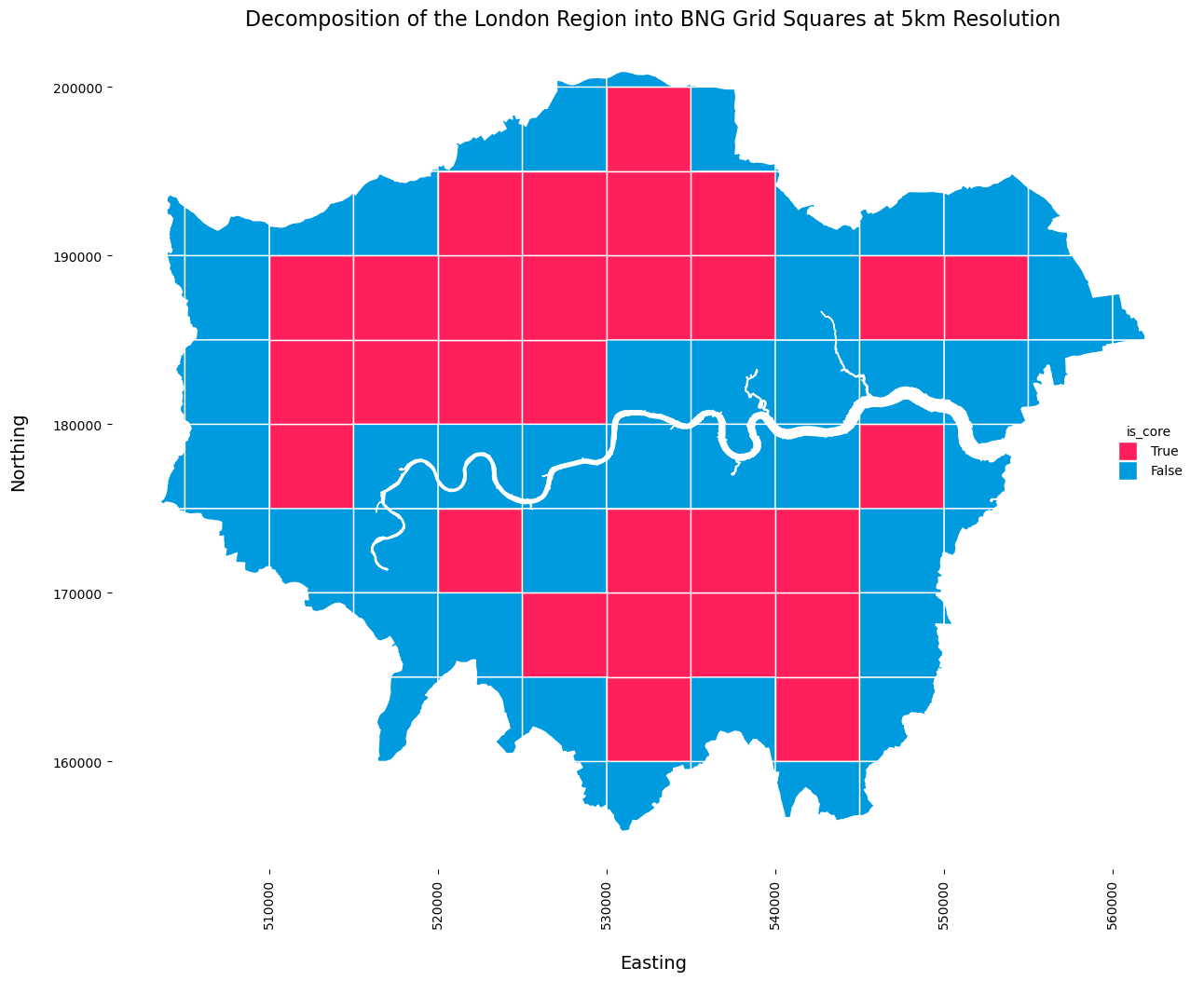
Decomposes each geometry in the input GeoPandas GeoDataFrame bounded by their presence in BNG grid squares at the specified resolution. Applies the geom_to_bng_intersection function to the active geometry column of the input GeoDataFrame, which is expected to be set and in the OSGB36 / British National Grid coordinate reference system (CRS) (EPSG:27700).
The resulting BNGIndexedGeometry objects are exploded into individual rows, with each row containing a new column for each BNGIndexedGeometry object property: bng_ref, is_core, and geom.
The input GeoDataFrame geometry column is replaced with the geom property of the BNGIndexedGeometry objects. The input geometry column can be retrieved if required by joining the resulting GeoDataFrame with the original GeoDataFrame on the index (if not reset), or using a feature identifier. Dropping the original geometry column reduces memory usage and simplifies the resulting GeoDataFrame.
All non-geometry columns from the original GeoDataFrame are retained in the resulting GeoDataFrame.
The columns added to the exploded GeoDataFrame:
bng_ref: TheBNGReferenceobject representing the grid square corresponding to the decomposition.is_core: A Boolean flag indicating whether the grid square geometry is entirely contained by the input geometry. This is relevant for Polygon geometries and helps distinguish between “core” (fully inside)and “edge” (partially overlapping) grid squares.geometry: TheShapelyGeometry representing the intersection between the input geometry and the grid square. This can one of a number of geometry types depending on the overlap. Whenis_coreis True, geom is the same as the grid square geometry.
[20]:
# Create a copy of the GeoDataFrame
_gdf_london = gdf_london.copy()

# Decompose the London Region into a simplified representation
# bounded by its presence in each BNG grid square at a 5km resolution
# Uses the gdf_to_bng_geom_intersections function from the osbng.indexing_gpd module
_gdf_london_exp = gdf_to_bng_intersection_explode(gdf=_gdf_london, resolution="5km")

# Return the first few rows of the GeoDataFrame
_gdf_london_exp.head()
[20]:
| rgn24cd | rgn24nm | bng_ref | is_core | geometry | |
|---|---|---|---|---|---|
| 0 | E12000007 | London | BNGReference(bng_ref_formatted=TQ 3 9 SE, reso... | True | POLYGON ((540000 190000, 540000 195000, 535000... |
| 1 | E12000007 | London | BNGReference(bng_ref_formatted=TQ 2 8 SW, reso... | True | POLYGON ((525000 180000, 525000 185000, 520000... |
| 2 | E12000007 | London | BNGReference(bng_ref_formatted=TQ 4 7 NE, reso... | True | POLYGON ((550000 175000, 550000 180000, 545000... |
| 3 | E12000007 | London | BNGReference(bng_ref_formatted=TQ 3 6 NW, reso... | True | POLYGON ((535000 165000, 535000 170000, 530000... |
| 4 | E12000007 | London | BNGReference(bng_ref_formatted=TQ 3 9 NW, reso... | True | POLYGON ((535000 195000, 535000 200000, 530000... |
[21]:
# Create matplotlib figure and axis
f, ax = plt.subplots(figsize=(15, 15))

# Plot the indexed and exploded London Region GeoDataFrame
_gdf_london_exp.plot(
    ax=ax,
    edgecolor="#fff",
    linewidth=1,
    color=[
        "#ff1f5b" if is_core else "#009ade" for is_core in _gdf_london_exp["is_core"]
    ],
)

# Set the title
ax.set_title(
    "Decomposition of the London Region into BNG Grid Squares at 5km Resolution",
    fontsize=16,
)

# Add a categorical legend for the is_core column
legend_elements = [
    Line2D(
        [0],
        [0],
        marker="s",
        color="w",
        label="True",
        markerfacecolor="#ff1f5b",
        markersize=14,
    ),
    Line2D(
        [0],
        [0],
        marker="s",
        color="w",
        label="False",
        markerfacecolor="#009ade",
        markersize=14,
    ),
]
# Add legend to the plot
legend = ax.legend(handles=legend_elements, title="is_core", loc="center right")
# Remove legend frame
legend.get_frame().set_linewidth(0)

# Set the aesthetics for the matplotlib axes
plot_aesthetics(ax)
The example below demonstrates how the same GeoDataFrame _gdf_london_exp could be derived using more verbose logic via the geom_to_bng_intersection function.
[22]:
# Create a copy of the GeoDataFrame
_gdf_london = gdf_london.copy()

# Decompose the London Region into a simplified representation
# bounded by its presence in each BNG grid square at a 5km resolution
# Uses the geom_to_bng_intersection function from the osbng.indexing module
# Returns a list of BNGIndexedGeometry objects
_gdf_london["bng_ref_5km"] = _gdf_london["geometry"].apply(
    lambda x: geom_to_bng_intersection(geom=x, resolution="5km")
)

# Drop the original geometry column
_gdf_london = _gdf_london.drop(columns=["geometry"])

# Explode the bng_ref_5km column to separate rows for each BNGIndexedGeometry object
_gdf_london_exp = _gdf_london.explode("bng_ref_5km", ignore_index=True)

# Extract the bng_ref, is_core, and geom properties into new columns
_gdf_london_exp["bng_ref"] = _gdf_london_exp["bng_ref_5km"].apply(lambda x: x.bng_ref)
_gdf_london_exp["is_core"] = _gdf_london_exp["bng_ref_5km"].apply(lambda x: x.is_core)
_gdf_london_exp["geometry"] = _gdf_london_exp["bng_ref_5km"].apply(lambda x: x.geom)

# Drop the original bng_ref_5km column
_gdf_london_exp = _gdf_london_exp.drop(columns=["bng_ref_5km"])

# Set the geometry column to the new geometry column
_gdf_london_exp = _gdf_london_exp.set_geometry("geometry")
# Set the CRS to British National Grid (OSGB36)
_gdf_london_exp = _gdf_london_exp.set_crs(27700)

# Return the first few rows of the GeoDataFrame
_gdf_london_exp.head()
[22]:
| rgn24cd | rgn24nm | bng_ref | is_core | geometry | |
|---|---|---|---|---|---|
| 0 | E12000007 | London | BNGReference(bng_ref_formatted=TQ 3 9 SE, reso... | True | POLYGON ((540000 190000, 540000 195000, 535000... |
| 1 | E12000007 | London | BNGReference(bng_ref_formatted=TQ 2 8 SW, reso... | True | POLYGON ((525000 180000, 525000 185000, 520000... |
| 2 | E12000007 | London | BNGReference(bng_ref_formatted=TQ 4 7 NE, reso... | True | POLYGON ((550000 175000, 550000 180000, 545000... |
| 3 | E12000007 | London | BNGReference(bng_ref_formatted=TQ 3 6 NW, reso... | True | POLYGON ((535000 165000, 535000 170000, 530000... |
| 4 | E12000007 | London | BNGReference(bng_ref_formatted=TQ 3 9 NW, reso... | True | POLYGON ((535000 195000, 535000 200000, 530000... |